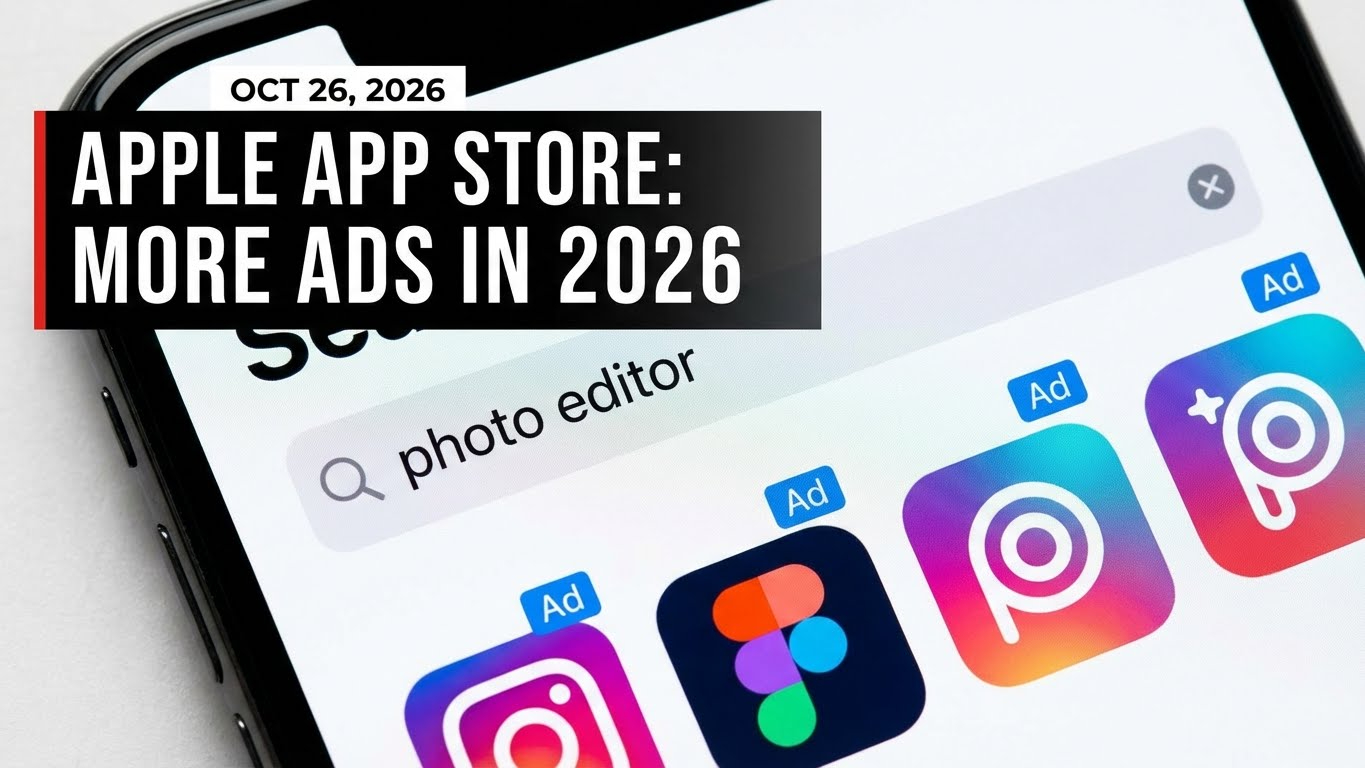
The digital
advertising landscape is in constant flux, and Apple's App Store is no
exception. In a significant move set to redefine app discovery and
monetization, Apple will introduce additional ad placements across its search
queries in 2026. This expansion promises new opportunities and challenges for
developers, demanding a sophisticated and adaptive strategy to thrive in the
evolving ecosystem.
Key Developments in
App Store Advertising (2026)
The upcoming changes
signal a clear shift in Apple's approach to App Store monetization. Developers
need to understand these core developments to prepare effectively:
- Expansion of Search Ads: Moving beyond the current single
prominent ad spot, 2026 will see new ad placements integrated further down
search results. This means more visibility for advertisers within organic
listings.
- Placement Determination: Crucially, advertisers cannot bid
for specific positions. Ad placement will be dynamically determined by a
combination of bid amount and ad relevance, ensuring a level playing
field. Existing search ad campaigns will automatically qualify for these
new spots.
- Billing Mechanism: The familiar cost-per-tap (CPT) or
cost-per-install (CPI) models will remain the standard billing methods,
providing continuity for budgeting and campaign management.
- "Apple Ads" Rebranding: In an earlier, strategic move in
early 2025, "Apple Search Ads" was officially rebranded to
"Apple Ads." This change reflects a broader advertising scope
that extends beyond mere search, hinting at future expansions.
- Potential Apple Maps Ads: Rumors abound that 2026 could also
bring ad placements to Apple Maps. This would allow businesses to pay for
prominent placement in Maps search results, offering a new avenue for
location-based advertising.
Impact on
Developers and Monetization
For developers, these
changes present a complex interplay of challenges and opportunities that will
significantly influence their monetization strategies.
- Dual Challenge and Opportunity: The expansion of ads offers enhanced
app discovery, a critical advantage given that approximately 65% of App
Store downloads originate from search. However, developers must also
navigate stricter privacy guidelines, such as the App Tracking Transparency
(ATT) framework (introduced in 2025), which can directly impact the
efficacy of targeted advertising.
- In-App Purchase (IAP) System: Apple continues to champion its
robust IAP system, with its familiar commission structure of up to 30%.
This remains a primary revenue stream for many app creators.
- External Payment Systems: Recent U.S. legal shifts have opened
doors for developers to direct users to external payment systems for
digital goods. While this offers flexibility, Apple levies a tiered 12% or
27% commission on purchases made within seven days of tapping an external
link, requiring careful consideration of financial models.
- Developer Earnings: Encouragingly, small developers have
reportedly seen a substantial 76% increase in earnings between 2021 and
2024, indicating a growing and potentially lucrative market despite the
evolving rules.
 Figure 1: The evolving landscape of App Store monetization strategies,
highlighting growth and new payment models.
Figure 1: The evolving landscape of App Store monetization strategies,
highlighting growth and new payment models.
Strategic Approach
to Apple Ads Placements
To maximize impact,
developers must strategically leverage the diverse ad placements available.
- Existing Placements:
- Search Tab: Ads appear before a user types a
query, ideal for broad visibility.
- Today Tab: The App Store homepage offers
maximum visibility for major campaigns.
- Product Pages: Ads in the "You Might Also
Like" section target users researching similar or competitor apps.
- Prioritization for 2026:
- Search Results Ads: Essential for capturing high-intent
users directly at the point of search.
- Search Tab Ads: Crucial for brand awareness and
top-of-funnel engagement.
- Today Tab Ads: Reserved for major campaigns
demanding high visibility and broad reach.
- Product Pages Ads: Effective for precise targeting of
users already engaged with related app content.
- Benefits of Multi-Placement Strategy: A holistic approach across various
placements can lead to increased brand searches and downloads, often
resulting in a lower overall cost per acquisition (CPA) by synergizing
efforts.
 Figure 2: Visualizing comprehensive Apple Ads placements and their
benefits for a multi-placement strategy.
Figure 2: Visualizing comprehensive Apple Ads placements and their
benefits for a multi-placement strategy.
Advanced Tools and
Practices for Strategy Refinement
To truly excel,
developers must harness advanced tools and adopt best practices:
- Custom Product Pages (CPPs): A powerful feature allowing
developers to create up to 35 tailored App Store pages. These can align ad
creatives and landing experiences with specific keywords and audience
segments, enhancing conversion rates.
- Bidding Strategies:
- Calculate a baseline CPT bid by
multiplying your target CPA by the expected conversion rate.
- Gradually increase daily budgets for
well-performing campaigns to maintain profitability and scale success.
- Audience Targeting: Surprisingly, broad filters and
strong keyword optimization often outperform overly restrictive
segmentation. This is especially true given that over 78% of App Store
search activity comes from users with Personalized Ads disabled.
- Campaign Setup: Always initiate campaigns in
Advanced Mode to unlock full control over settings, targeting, and bidding
strategies.
- Mobile Measurement Partners (MMPs): Integrating with MMPs (e.g.,
AppsFlyer, Adjust) is critical for comprehensive attribution. This enables
tracking post-install events and accurately measuring key performance
indicators (KPIs) like Return on Ad Spend (ROAS) and trial-to-paid conversion.
- View-Through Attribution: Integrated in April 2025, this
feature significantly enhances measurement capabilities, providing deeper
insights into ad impact.
Broader Mobile App
Landscape Trends (2026)
Beyond direct ad
placements, several overarching trends will shape the mobile app environment:
- App Store Optimization (ASO): Remains fundamental. Over 70% of App
Store visitors discover apps through organic search. A strong ASO strategy
complements paid campaigns by lowering Cost Per Install (CPI) and
sustaining organic growth. This includes advanced keyword research, optimizing
titles/descriptions with latent semantic indexing, and active review
management.
- AI in Mobile Advertising: Artificial intelligence is expected
to play an increasingly vital role, optimizing ad spend, analyzing user
intent, predicting churn, and generating adaptive ad copy to maximize
effectiveness.
- Hyper-personalization: While privacy regulations evolve,
the drive for hyper-personalization continues, requiring transparent user
consent and ethical data practices.
- Engaging Content: The importance of high-quality
visual assets, including short-form videos and interactive ads, will
continue to grow as users demand more immersive experiences.
- In-App Advertising: Effective in-app advertising within
one's own application, focusing on timing and user-friendly rewarded video
formats, will remain a significant developer monetization channel.
Conclusion
The introduction of
additional ads across search queries in Apple's App Store in 2026 intensifies
the competitive environment for app developers. Success will depend on a
proactive and integrated strategy that embraces the expanded "Apple
Ads expansion," prioritizes robust "App Store
Optimization," and maintains awareness of "privacy" and "user
experience." Strategic leveraging of "search queries
ads," implementing advanced bidding with tools like "Custom
Product Pages," and continuous performance monitoring
through "Mobile Measurement Partners" are key for
navigating this evolving landscape and achieving sustainable growth and
effective "developer monetization."