I. Intro: The Big Day is Almost Here!
Another iOS update. It arrives, heralded by digital
trumpets, promising a symphony of improvements. Or perhaps a cacophony of
unforeseen issues. Regardless, iOS 26.2 is poised to land, bringing with it a
fresh wave of features and, undoubtedly, a renewed cycle of debate.
The anticipated window for this digital delivery is
between December 8-10, 2025. Those of us residing in the
Eastern Time Zone, particularly in the garden state of New Jersey, should brace
ourselves for the update around 1:00 p.m. That’s 10:00 a.m.
for our Californian counterparts.
But why should we care? What novelties does this iteration
bring, and what familiar controversies might it reignite?
II. What's Inside the 26.2 Box? (The Goodies We're
Getting)
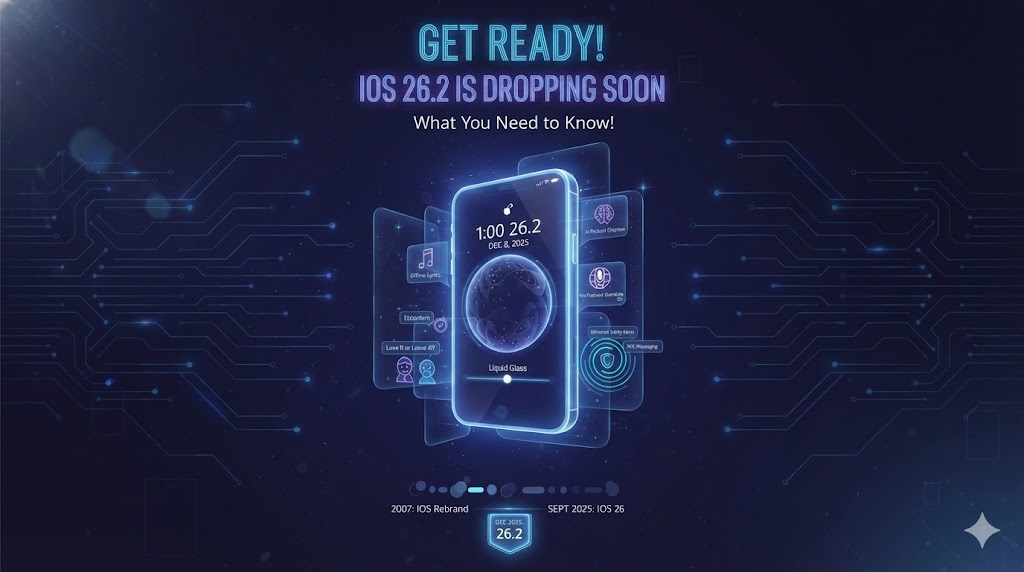
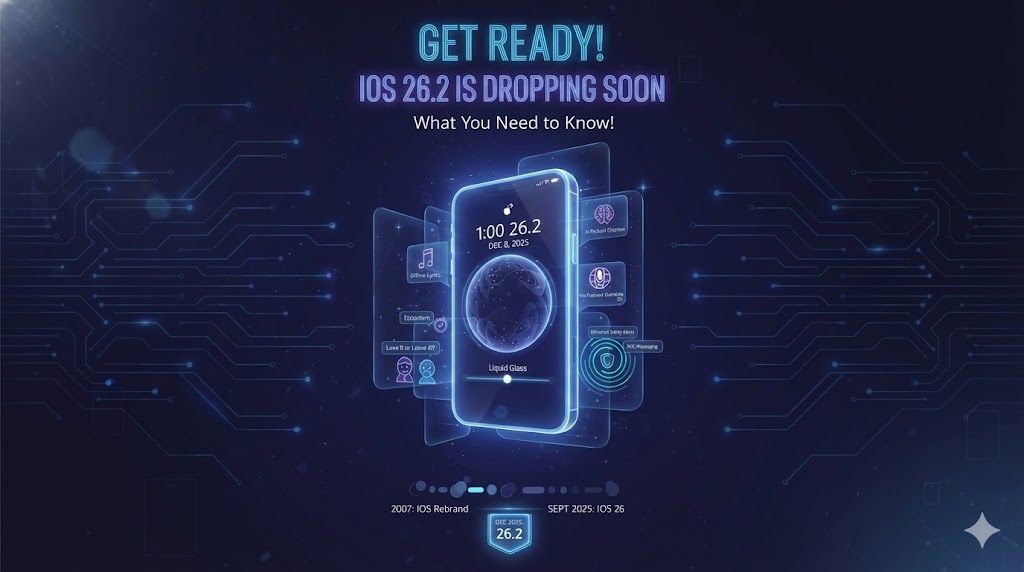
iOS 26.2 offers a mixed bag of refinements and additions.
✓
Music to Your Ears (and Eyes!): The introduction
of offline lyrics in Apple Music is a welcome practicality.
✓
Podcast Smarts: AI-generated chapters in Apple
Podcasts promise a more navigable listening experience.
✓
Freeform Fun: New features for tables in the
Freeform app.
✓
Lock Screen Level-Up: A point of contention
since its initial unveiling, the Lock Screen receives enhanced customization,
notably the "Liquid Glass" slider for clock transparency. Is this
aesthetic progress or a step towards visual clutter? The debate continues, but
at least we now have some control.
✓
Global Chit-Chat: AirPods Live Translation
expands to the European Union.
✓
Reminder Refresh: A new alarm capability for the
Reminders app.
✓
News Nudges: Updates to the Apple News app.
✓
Sleek Swipes: Revamped menu animations aim for a
smoother feel.
✓
CarPlay Convenience: The ability to disable
pinned messages in Messages is a small but significant victory for driving
focus.
✓
Safety First: An "Enhanced Safety
Alerts" section provides centralized threat alerts and improved
location-based delivery.
III. A Trip Down Memory Lane: Apple's Update Philosophy
To understand the present, a glance at the past is
necessary. The evolution from iPhone OS to iOS (the rebranding occurred in
2010) marks a significant chapter in mobile computing.
The annual rhythm is familiar: a major iOS release (like iOS
26) typically follows the Worldwide Developers Conference (WWDC) in September.
The subsequent point releases – the x.1, x.2 updates – are not mere bug
squashing exercises; they often introduce entirely new features, as
demonstrated by this 26.2 update, arriving predictably within Apple's
mid-December timeframe.
IV. The Current Vibe: Love it or Leave it?
The Apple ecosystem inspires devotion and derision in equal
measure. The reasons for this polarization are complex, but let us consider
some key points.
The Apple fanbase clings to several tenets: the long-term
support for older devices (reportedly up to 7 years for major updates, with
security patches extending even further); the seamless ecosystem integration
facilitated by features like Handoff, AirDrop, iMessage, and iCloud; and the
generally intuitive user interface.
However, the naysayers also raise valid concerns. Initial
bug reports after major releases are almost a given: unresponsive screens,
battery drain, and overheating. Performance degradation on older devices is
another recurrent complaint. And then there are the aesthetic choices, such as
the "Liquid Glass" slider in iOS 26.2. Is it a bold innovation or an
unnecessary distraction? Some critics have described it as "sloppy."
Hardware limitations are an obvious factor.
V. Hot Takes & Headaches: The Controversies of iOS
The path of iOS has not been without its thorns.
Update Woes:
Specific updates have, in the past, triggered cellular
connectivity issues and overheating problems. The UI redesigns, notably the
Photos app in iOS 18, and the ongoing "Liquid Glass" debate, are
points of contention.
Broader Ecosystem Battles:
The "walled garden" approach of Apple's App Store,
with its 30% commission, has faced antitrust scrutiny (witness the Epic Games
vs. Apple legal battle). The Digital Markets Act in the EU is forcing Apple to
allow alternative app marketplaces, raising complex questions about security
and user experience. The saga surrounding RCS messaging also comes to mind,
where Apple initially resisted before adopting it in iOS 18.4. Finally, the
high cost of entry, coupled with restrictive repair policies, contribute to the
ongoing debate.
VI. Crystal Ball Gazing: The Future of iOS and the Apple
Ecosystem
The future, as always, is shrouded in a degree of
uncertainty, but some trends are becoming apparent.
AI, AI, and More AI! Apple Intelligence is
gradually rolling out, promising smarter notifications and an enhanced Siri
with improved contextual understanding. Visual intelligence will enable users
to ask questions about screen content and translate messages.
Beyond the Phone: The influence of AR/Spatial
Computing, exemplified by the Vision Pro, will continue to shape the iOS
landscape. Expect developers to build mixed reality experiences. The expansion
of health and wellness features, evident in the Apple Watch Series 11 (which
reportedly includes hypertension detection!), coupled with AI-powered Health
app updates, points towards a future where iOS plays an increasingly prominent
role in personal well-being. A potential "Command Centre" device,
akin to an Echo Show, along with a smart camera doorbell with Face ID, suggests
a deepening integration with the smart home.
Privacy will remain a key focus, with continued emphasis on
on-device machine learning and private cloud processing for data protection.
And, of course, there will be new hardware: the iPhone 17 series is rumored to
feature ProMotion OLED displays across the board, upgraded cameras, and a
"Slim" variant.
The overarching goal appears to be a more intelligent,
seamlessly integrated, and personalized user experience.
VII. Conclusion: To Update or Not to Update?
iOS 26.2 offers a mixed bag of features and design tweaks.
The update cycle is a familiar one: initial quirks are likely, but robust
security and long-term support are generally reliable.
The question remains: will you click that "Download
& Install" button immediately, or will you wait for the early adopters
to navigate the inevitable pitfalls? The choice, as always, is yours. Share
your thoughts in the comments below!